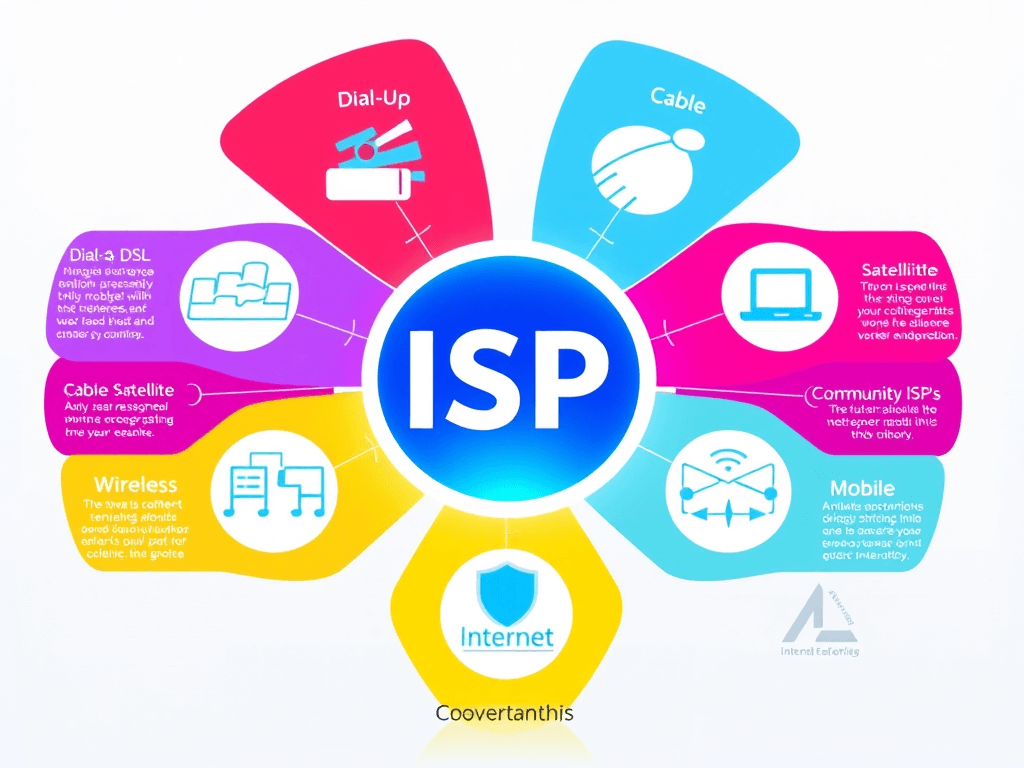
There are several different types of Internet Service Providers (ISPs) that cater to various user needs. Here are the main types:
- Dial-Up ISPs:
- Connect users to the Internet using a telephone line and a modem.
- Generally slower speeds, suitable for light browsing.
- DSL (Digital Subscriber Line) ISPs:
- Use existing telephone lines for Internet access.
- Offers higher speeds than dial-up, with dedicated lines for data.
- Cable ISPs:
- Provide Internet through cable television lines.
- Typically faster speeds and allows simultaneous Internet and TV usage.
- Fiber-Optic ISPs:
- Use fiber-optic cables to deliver incredibly fast Internet speeds.
- Best option for heavy users, including gaming and streaming.
- Satellite ISPs:
- Use satellite technology to provide Internet service, useful in remote areas.
- Generally has higher latency and lower speeds compared to terrestrial ISPs.
- Wireless ISPs (WISPs):
- Provide broadband wireless Internet access in specific areas, often using radio signals.
- Ideal for rural areas where traditional wired connections are unavailable.
- Mobile ISPs:
- Offer Internet service through mobile networks, allowing access via smartphones and other devices.
- Can be 4G or 5G, catering to on-the-go users.
- Community ISPs:
- Non-profit organizations that offer Internet services to local communities.
- Often focused on providing affordable access to underserved areas.
- Content Delivery Networks (CDNs):
- While not traditional ISPs, they provide services to improve the delivery speed of content over the Internet.
- Typically used by businesses and websites for enhanced performance.
Each type of ISP has its own strengths and weaknesses, making them suitable for different users and locations.

No responses yet